|
My introduction to
Palmetto Bluff in the Lowcountry is a pleasant enough one. I find a
concealed right turn off the main county road that runs through
Bluffton, and just beyond an open gate and a bend in the road is a new
wood hut on a center island, looking a lot like a toll booth in which a
carpenter has taken great pride. A gregarious woman smiles at me as I
pull up, like she’s been awaiting my arrival all day.
“Welcome!” she
beams.
After a pleasant
exchange, she provides me with directions to the Inn, though I have to
ask again, because I’m convinced she misspoke.
“Five miles?!”
“Five miles, dear,
you can’t miss it. Have a wonderful stay.”
I shift back into
gear and pass through the gates, and large, neat rows of palmettos and
oaks narrow around a road that gently curves under an arch from their
foliage, as if I’m in a car commercial. And the drive is five miles,
taking several minutes at a good pace, to pass through 20,000+ acres of
pristine wilderness and pull up to the stop sign at the edge of this
tiny colonial resort town.
On what was once
Indian land, and in the 19th century, site of a collection of
cotton plantations and personal land holdings, Palmetto Bluff as a real
estate asset was consolidated and sold to a wealthy banker from New York
City, whose son promptly began construction on the grandiose ‘Palmetto
Lodge,’ a backcountry family retreat. The deed to Palmetto Bluff changed
hands a couple of times in the first half of the century, and the
original Lodge was destroyed by fire in 1926, but when manufacturing
conglomerate Union Camp bought the land in the war era, they rebuilt the
lodge as an exclusive hunting retreat for executives and international
sportsmen. The setting, and abundance of wildlife, set the perfect
atmosphere for a relaxed vacation, and when Crescent Resources, a real
estate development arm of Duke Energy, purchased the land in 2000, they
saw the opportunity to develop an extraordinary project, in the spirit
of backcountry community living, on one of the last unspoiled oceanfront
locations. Today, Palmetto Bluff is just beginning to realize this
potential.
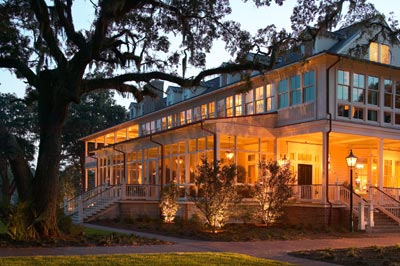
Squeezed onto an
isthmus of ancient maritime forest along the Atlantic shoreline just
north of Savannah beside the May River delta, the Inn at Palmetto Bluff
is only accessed by the gated road that brings me to the Inn’s front
drive. Here, a retro-colonial town is rising up in the Lowcountry, based
around the gloriously classic inn, built adjacent to the foundation of
the original hunting lodge. Across a small footbridge to a small
peninsula squeezed between the salt marshes and an inland lagoon lie 50
luxury cottages, arranged in an almost camp-like style amid towering
silver oaks, palmettos, palms, and unobtrusive Lowcountry landscaping.
Each features the most luxurious modern amenities contained within small
buildings that reflect the region’s architectural heritage; pine floors,
vaulted ceilings, and verandas with stunning views of the May River
delta are the cornerstone of these unique private hideaways.
Within the ‘town,’
if a single block can be described as such, there is a cobble driveway,
a classic café, a bookstore, and little else in what could best be
described as the town square. Guests mill about peacefully, at a pace
that seems to roll with the long summer days and languid tides of the
nearby waterway. Keeping with the natural pace of Palmetto Bluff, the
Inn offers bicycles complimentary to guests, allowing them to explore
the pristine environment and sensitive developments on the property.
Canoeing, kayaking, and fishing along the inland waterways is a popular
activity as well, either for the pure pleasure of unmotorized travel in
the wilderness, or on an informative, guided tour of Palmetto Bluff’s
history and archaeological ruins. Guests hoping for a spiritual journey
somewhat less taxing can find refuge at the spa, set in the verdant,
sprawling countryside, and easily capable of lulling one into a peaceful
state of mind, body, and heart.
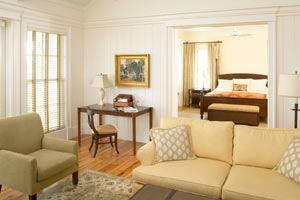 Within,
there are (unconventionally) no rooms. Instead, the main floor and terrace
is home to the reception area and the River House dining room, where the
finest ingredients of the region are fused into classic and elegant
takes on the local cuisine. Among the starters, a bisque with lump crab
appears standard until it is served with tableside with sherry. Oysters
are paired with creamed collards and spinach, diver scallops with corn
pudding and a light herb salad. Among mains, the lump crab cakes, like
the endorsement they receive from the attentive staff, are dazzling, set
over a summer succotash and herb butter. Beef fillet and beautifully
robust lamb and pork chops are treated right, cooked to perfection and
garnished
with sides that pair wonderfully with the meat. With an extensive
international wine list and a knowledgeable staff, a proper pairing is
ensured, and the atmosphere of watching the setting sun colour the fat
oaks, marshlands and flower beds guarantees a second-to-none dining
experience. At a time like that, settling into the Palmetto Bluff
oceanfront community is a welcome rite of passage. The sensation of
being lost in a wildlife refuge is incomparable—even if, in the back of
your mind, you know the rest of the world is just five miles away. Within,
there are (unconventionally) no rooms. Instead, the main floor and terrace
is home to the reception area and the River House dining room, where the
finest ingredients of the region are fused into classic and elegant
takes on the local cuisine. Among the starters, a bisque with lump crab
appears standard until it is served with tableside with sherry. Oysters
are paired with creamed collards and spinach, diver scallops with corn
pudding and a light herb salad. Among mains, the lump crab cakes, like
the endorsement they receive from the attentive staff, are dazzling, set
over a summer succotash and herb butter. Beef fillet and beautifully
robust lamb and pork chops are treated right, cooked to perfection and
garnished
with sides that pair wonderfully with the meat. With an extensive
international wine list and a knowledgeable staff, a proper pairing is
ensured, and the atmosphere of watching the setting sun colour the fat
oaks, marshlands and flower beds guarantees a second-to-none dining
experience. At a time like that, settling into the Palmetto Bluff
oceanfront community is a welcome rite of passage. The sensation of
being lost in a wildlife refuge is incomparable—even if, in the back of
your mind, you know the rest of the world is just five miles away.
|