|
As
the Naples golf scene continues to explode, new destinations emerge
every year, and one of the best has literally blossomed straight out of the Florida wilderness in Bonita
Bay, at the northwest tip of the Naples region of Southwest Florida.
Raptor
Bay, a joint effort between WCI Communities and the Hyatt Regency
Coconut Point, is the latest Raymond Floyd signature course to open in the
area, a venture that only a select group of current and former players have tried.
The prominence of Floyd designs in the area, and the luxury Raptor Bay had
in enlisting the esteemed player's services, is surely tied to his
affinity for the area. Floyd makes his home in Miami, and if Raptor Bay is
any indication, his work is a reflection of his familiarity with both the
game and his experience in livening the 'bland' landscape that South
Florida affords golf architects.
Coupled with Floyd's
influences and his principles of design, the result is an exciting and
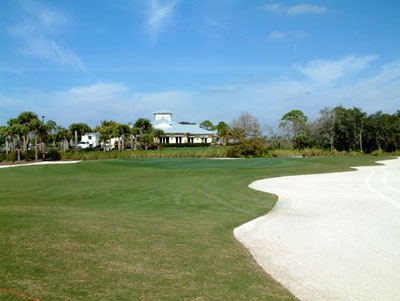
mature layout. The green complexes are reminiscent of Donald Ross’ efforts at
Pinehurst, slightly raised and often surrounded by closely mown chipping
areas. This sleek look to the course extends down the fairways, as a
couple of other characteristics should be noted. Greenside bunkers are an
anomaly, and the fairways are framed not by rough but by large stretches
of coquina-shell waste bunkers. With all grass areas maintained at fairway
height, golfers may think the course benign, but like Pinehurst, it is the angle from
which one approaches the green that is paramount to good scoring. The
aforementioned fall-away greens protect themselves from any
poorly-struck shot, while a scattering of water hazards and marsh,
commonplace on a Florida linksland, will snare some errant shots as well.
What
most golfers won’t recognize at Raptor Bay are the lack of homes that
surround the course and the truly unique experience, which gives a chance
to connect with the natural environment. Raptor Bay has taken this
responsibility to heart, and has taken pains to inform the golfer of their
role in providing and protecting this habitat. The GPS, which comes
equipped on all carts, is both a yardage book and an educational tool. With the map
of each hole comes facts about a new species of bird, whose names grace
the inward and outward halves of the course. Perhaps the first lesson in
ornithology at Raptor Bay is that the birds are top priority: plans
for the addition of a new nine holes,
slated to open in the fall of 2004, were halted because common
migration patterns would have been disrupted.
The
breadth of the landing areas is immediately noticeable. The opening
par five, measuring 585 yards, must seem at least that wide across the
fairway. While water lines the right side of the hole, only an early
wayward shot is in danger of finding it on the drive or lay-up shot. As
the golfer approaches the green, however, the hazard narrows in,
with the water now guarding the right side and the waste bunker wrapping
around the left and backside of the green. The bunker has a low lip, and
putter is often the choice from both here and the collection areas. Floyd
allows the golfers to get the kinks out of their swing with an easy opener,
and starting with a par or birdie are not uncommon.
By
the time the golfer arrives on the tee of the par-three fourth hole, their game
best be in order. This 168-yard hole demands
a solid iron shot, which should favour the right side of the green. The
swale front left leaves a difficult up-and-down, and any pin cut in the
back-left corner is nothing less than diabolical
Eight
is the first short par four (measuring 381 yards) on the course, and the
raised up green provides plenty of options from the tee. The most common
miss on this hole is from the golfer who cannot fully commit to the shot,
which often happens when a drive too close to the green leaves a
less-than-full approach. Laying up off the tee may provide the golfer with not
only the more appropriate angle, but the chance to hit a full short iron
into this treacherous green.
The
front nine finishes with perhaps the hardest hole on the side, the
443-yard par four. Water stands guard on the left and is in play
from the tee and the approach, though a sliver of a bunker does catch
balls missing left of the green. Misses should find the right side, which allows
for a decent chance at getting up and down for par.
Going
into the back nine, 11 can be a turning point for the round, particularly
to the aggressive player. At just 322 yards from the furthest tee deck,
the hole begs for players to pull out the driver and aim for eagle. Palm
trees and a waste bunker protect the left side,
but the true hazard here is the sharply
undulating two-tiered green. As with any good short par four, the player
must find the proper level or a three-putt is likely. This challenge is even greater
with a driver, meaning the wedge is often the better choice.
Following
up on the long par-three 13th, the short 15th is the best short hole on the
course. This devilish little hole boasts a massive green that is capable
of being a golfer's best friend (or worst enemy) with its untamed slopes.
Certain pin positions act as backstops to the short-iron approach, and
while finding the green is a simple task, getting the ball in the hole is
a more daunting proposition.
After
starting with a par five, Raptor Bay closes in the same fashion. The
639-yard hole means not even the longest hitters can challenge the green in
two shots. The trouble on the home hole looms left – in the form of a coquina
waste area and
water – while Floyd provides some bailout area to the right. For the
rest of the golfers, the lay-up should be positioned on the right side of
the fairway, allowing the golfer to view the opening to this
extraordinarily deep green.
While
the seamless melding of environment and golf course that takes place at
Raptor Bay may be out of the ordinary for most Florida courses, the trend
is a welcome one. Recognized by Audubon International as a Gold Signature
Member (the first resort course to garner this certification and
only the third course in the world) for its work with nature, the course provides an oasis from the
condo development that seems to be defining more and more of Florida’s golf courses. Floyd
has certainly gotten off on the right foot in his design career, and he
should be given such parcels to work with in the future. |