|
The TPC at the Canyons course is one of the newest additions to the PGA Tour's prestigious network of Stadium courses, and the first of its kind in the greater Las Vegas area. Designed by architect Bobby Weed, who took consulting advice from Tour great Raymond Floyd, the TPC at the Canyons began playing host to the Las Vegas Senior Classic on the Senior PGA
TOUR in the spring of
1997, and is the only public course in Las Vegas that hosts the
pros (co-hosting the Las Vegas Invitational). With the TPC
name comes the service that has made the TPC network so famous, from the bag drop to the
clubhouse to the exciting and dramatic layout. The
Canyons is no exception.
At 7,063 yards, and with a 73.0 course rating, the TPC at the Canyons is a stern test for anyone. The course winds through natural desert vegetation that has been keep intact, and each hole is carved carefully so as to enhance the natural beauty of the surrounding canyons and arroyos. With significant elevation changes, ravines, plenty of sand traps, and hundreds of wildlife species often spotted in the region, the environmentally-conscious TPC at the Canyons is much more eventful than a regular round of golf.
Good rounds at the TPC course are usually determined in the opening and closing stretches, where the toughest holes are found. The highlights on the back nine includes the run of holes beginning at the 12th, which works its way around the arroyo splitting the back nine. The canyon holes are certainly among the most memorable, but after leaving the canyon, the finishing hole is sure to cause problems for those golfers hoping to close with a good score intact.
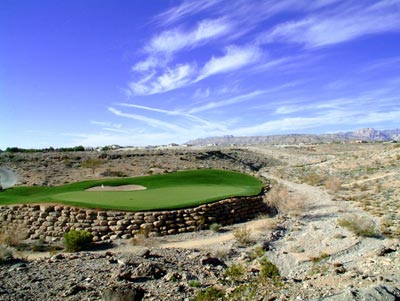
The second is a beautiful downhill par three with a huge green. The green is surrounded by desert and a bunker to the right of the green. Be careful of the club selection due to the wind and the severe elevation change. The ‘island’ green in the desert creates one of the most visual stunning holes on the course.
The third is a long downhill par four, which is rated as the hardest hole on the course. If you manage to avoid the two bunkers left off the tee, you will then be required to play a high approach shot to a green that is hard to hold.
The par five fourth is a long straight hole is a definite birdie hole. Keep the second shot to the left side of the fairway and you will be left a pitch to a green protected by a litter of bunkers. Providing the backdrop is the lovely JW Marriott Las Vegas, which stands just beyond the fourth green.
The second of a strong series of par threes, the seventh is a long par three that plays back into the wind. Bunkers guard the left, but the green opens up on the right side to afford the golf a chance to play a running shot in. Take plenty of club and miss right if you have to miss.
The par four tenth can play long if back into the wind and the golfer’s first glimpse of water is fairly tame. The green is another one which requires plenty of club to get back to the pin and deceives the golfer with its slightly uphill location.
The par three 12th is by far the shortest of the group, but by no means is it a pushover. The green is surrounded by desert and further guarded by a tough bunker in front, which must be avoided. The trickiest part of the hole is club selection, as the relatively high perch means that short irons can get knocked down in the wind fairly easily. Finding the shallow putting surface should be the foremost concern.
The fourteenth is the signature hole on the course and it is easy to see why. Your tee shot is played over the canyon to a fairway that opens up on the right if you hit it far enough. The fairway widens to the left, however the canyon cuts completely in front of the green so taking the longer route is not always favourable. This is a great hole, and the approach over the canyon is one of the most thrilling shots of the day.
The second long par five (both measuring over 600 yards), requires a tee shot down the left side to avoid the omnipresent canyon. The second shot should be to the far left to open up the best angle of approach. There are five bunkers surrounding the green, which is some 41 yards deep.
The 16th is a great par three where a diabolical bunker short of the green can wreak havoc on a good round. The green favours a high approach, and is deep enough to hold a long iron or fairway wood.
The 18th, a 447-yard par four,
is a great closing hole which is downhill (and hopefully downwind). The fairway is wide and has a significant slope, so that the longer the tee shot,
the more one will benefit from extra roll. There is water on the left side that comes into play on the approach, particularly if the pin is on the left side of the slender green. Three bunkers flanking the right side, make bailing out an unattractive option. The closing hole fits the mould of many a classic TPC finisher as a long and challenging par four, requiring some of the golfer’s best shots to the very end.
|