|
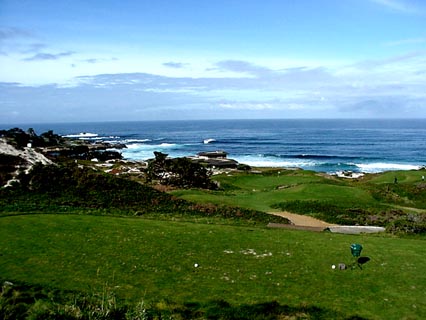
Robert Trent Jones, widely considered the patriarch of American golf architecture, is responsible for the majority of American courses built between 1940 and 1970. Whether Spyglass Hill will go down in history as his finest original design remains to be seen, but it is certainly his finest public creation. Opened in 1966 to complement Pebble Beach, the course boasts one of the best opening five holes in the game. When GOLF Magazine recently compiled a list of the best 500 golf holes in the world, it came as no surprise that the first, second and third holes all made the list – the maximum number of holes allowed in the rankings for any one course. (One and three both cracked the top 100.) The common complaint about Spyglass is the course’s sudden change in personality when it leaves the oceanside dunes of the first five holes and goes into the forest for the back nine. Though somewhat disjointed, the forest holes are solid, and if they didn’t have to withstand comparisons to the opening holes, would stand up on their own merit. Comparisons are inevitable, but minimize the challenge Jones had in laying out the course. The alternative would have been to use the oceanside dune holes as a finishing stretch, but the massive hill on the first hole would have been too difficult to negotiate. The first five holes, which blow most golfers away, start with one of best holes in the game. While opening holes are seldom the marquee draw of a championship course (Pebble Beach’s open stretch is relatively benign,) Spyglass is an exception to the rule the course gets off to a blazing start with the 595-yard first. The hole is truly grand, sweeping downhill and to the left, and as golfers comes around the corner they are greeted by the Pacific Ocean in the distance. While steeply downhill, few threaten this green in two, perhaps because of the perilous greenside bunkering or the undulations in the green. Spyglass truly rates among the best openers in the world. While many might expect a letdown after the dramatic first, "The Glass" comes back with a wonderful short par four. The second plays steeply uphill to a green that is surrounded by ice plant and sand. The smart move on this 349-yard hole is to lay back to the 135-yard mark; from there, an extra club is needed to get to the putting surface. For those golfers not familiar with ice plant, it is incredibly dense and difficult to recover from. Three is one of the two one-shotters in the first five holes, and it is certainly dramatic. Playing to only 152 yards from the tips, the hole is shortened because it plays downhill. Trouble surrounding the hole must be avoided, and a shot played into the front of the green will feed back due to the deceptive slope. The fourth may not only
be the best par four at Spyglass, but also the best par four in Jones' portfolio. Strategic and full of options, the fourth green is 50 yards deep and angled diagonally, so that pin position dictates the tee shot. With the pin back, the approach should be played from the right side of the fairway, while a front pin demands an approach from the left side. The green is wild and receptive to running shots, which are needed to get the ball all the way back to the pin. Ice plant and sand dunes surround this hole, and both must be avoided. Five, the last of the ocean holes, is a 183-yard par three with an interesting green that yields few one-putts. However, the four bunkers that surround the green are some of the most brutal on the course. It is wiser to play safely to the center of the green for par, than to play at the right pin position. The course turns uphill and back into the forest at the sixth, and while the mood of the course changes, the terrain remains challenging. The eighth is billed as "the longest hole under 400 yards." At 399 yards, this description could not be truer. The tee shot plays up a steep hill to a narrow tree-lined fairway, while the approach is even further uphill to a green guarded front right by a bunker. The yardage may be moderate for a par four, but its designation as the #1 handicap hole speaks volumes. After a string of longer holes, golfers get a brief respite at the 12th hole, which plays 178 downhill yards from the back tee. Water guards the left side and bunkers and a steep slope guard the right, and any shot even slightly offline will be punished. ‘Long John Silver’ is the name given to 14th hole, the final par five at Spyglass. This double dogleg measures a lengthy 560 yards, but its most imposing qualities are found around the green. A pond protects the right side of the green, and two bunkers flank it on either side. Difficult chips are frequent here, as the green, while wide, is quite shallow. While eight may be the toughest hole according to the card, average golfers would argue the 16th is harder. Playing a very long 462 yards from the back tee, the hole’s real challenge is cutting off any of the yardage. 16 doglegs sharply to the right, and the corner can only be challenged with a long high left-to-right ball. The second shot will be long, and should favour the right side of the green. The home hole, which gets its name from the course ‘Spyglass’, is perhaps the narrowest hole on the course. The bunker on the right and a few trees on either side of the fairway pinch the landing area even tighter. The green is framed at each corner by bunkers, and defends itself well with a ridge that separates the front and back of the green. While measuring only 6,862 yards from the Blue tees, Spyglass uses its dramatic terrain to create a challenging golfing experience. With its 75.3 course rating and 148 slope, the course can challenge the world’s best, as it does each spring at the Pebble Beach Pro-Am. However, for the average golfer, the course is both fun and reasonable, and an exhilarating trek through natural beauty. While the first five holes are the best five on the course, Spyglass has plenty left in its final 13, and is a fitting tribute to the man who revolutionized golf course design in America.
|