|
When
two giants form to create a golfing entity, they should look
at the example set by Ritz-Carlton Golf Resort Naples.
Ritz-Carlton, universally known as the provider of luxury
hotel services globally, and WCI Communities, a prominent name
in Florida golf development, have expertly melded their
talents into a world-class business golf destination. Taking
what they knew about service and hospitality, the signing of
architect and PGA Tour star Greg Norman was critical. Known
for his flair in life and golf, the 36 holes that doubly bear his name
('Tiburon' is Spanish for 'shark') were fully opened for play beginning
in November of 2002.
The more mature
Gold Course has now been open for four years, and while the
two courses share similar characteristics, dense forest and
extensive bunkering highlight the Gold course. The main
feature that Norman has incorporated in both courses is the
lack of rough, anywhere. Closely mowed chipping areas and
massive waste bunkers, compromised of crushed coquina shell,
shield green complexes. Watching guests become acclimatized to
both the look and the playability can be an amusing event. The
best advice to the first-time player is to treat the waste
areas as firm ground, and remember that you can ground your
club.
The Gold opens
with one of the best holes on the property, a medium-length
par five, which forces players to make a strategic decision.
The player wishing to go for the green in two shots has to
make a decision from the tee. The drive that favours the left
side of the fairway does not need to be as long, but it must
flirt with the water and forces an approach that requires the
player to carry the ball to the green. The drive favouring the
right will set up an approach that need not be played over the
hazard, but may demand the second shot be shaped from right to
left. The final option, and most conservative choice, is to
play the hole as a three-shotter, which still allows for a
very realistic chance at birdie.
Golfers must
adjust their games quickly to the presence of waste bunkers
and chipping areas. Though the lack of rough throughout the
course is welcome to the amateur player, one must play well
away from any water hazards, as no buffer exists to stop shots
from bounding through fairways and waste areas. This is true
at the fourth, which requires two solid shots, preferably
shaped to take advantage of the naturally terrain that allows
the approach to run in to the large green.
The eighth hole
draws particular attention to the challenges around Norman's
green complexes. The short 172-yard par three has one of the
most demanding tiered greens on the course, which requires
that the approach find the proper section of the green in
order to give the player a manageable two-putt.
The transition
into the back nine is smooth in terms of the landscape, moving
from tree-lined holes into more wide-open sandy territory,
highlighted by some great open vistas of the resort. Norman's
strategies abound on the back, especially at the short
370-yard 13th hole, with the combination of the waste bunker
flanking the right side and the deeper fairway traps on the
left side. The edged bunkering that protects the front left of
the green must be avoided, and a tee shot that flirts with the
waste area offers a much easier approach.
After battling the
difficult 14th and 15th holes, the golfer finds a respite in
the beautiful par-three 16th. Measuring 205 yards from the
back tees, the hole actually plays relatively easy. Three
bunkers safeguard the green, but there is ample space on the
putting surface to leave a straightforward two-putt.
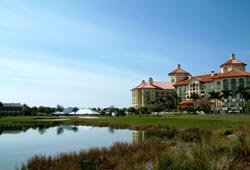
Closing
the Gold Course was not a difficult task for Norman, as the
land had already been allotted to mesh with the site of the
future hotel as its backdrop. The challenge of imagining and
carving the hole, however, still remained. The result is a
451-yard par four that plays over and around a massive pond.
The cape-style tee shot demands that the player bite off as
much of the dogleg as possible, so as to leave a shorter
approach. From there, the approach must work its way towards a
green that juts into the water, while a bunker short of the
putting surface will snare wayward and conservative shots.
While closing with arguably the hardest hole on the course
offers a threat to the scorecard, it also offers the
opportunity to walk away with a very rewarding par.
|